Canal du Centre

Canal du Centre

Sunday, July 9, 2017

Lille, June 24-July 1

After lightening our bank account with 400 liters of diesel at the Captain Neptunia fuel barge in Wervick, off we went for France. The French/Belgian border follows the river for several kilometers so it wasn’t until a little after noon that we officially entered French territory. Our first stop would be Lille, the largest city in northern France. We had been told that the mooring facilities in the city were not the greatest so we decided to stay in the northern suburb of Wambrechies which has a nice halte along the busy commercial canal. As it turned out, there is a marina in Lille but we don’t like marinas much and they usually don’t like us because we’re pretty heavy for their pontoons. There is a very nice tie up just above the Grande Carre lock in a park that we might use if we come back. 
About 1:30 pm we rounded the corner into the very small space and tied up just next to the Ginguette de la Marine, one of thousands of similarly named establishments in France. A sort of waterside bar/restaurant that typically features music, this one dispensed with the music and stuck to the drinks and food. Luckily for us, it shut down around 11 pm and the crowd wasn’t really rowdy so we weren’t disturbed…much. We could have moored out on the main canal but with the large barges going by the wash put a pretty big strain on the lines. We decided inside was better.
A gentleman with his child in his arms watched us tie up and noticed our US and California flags. He took an opportunity to practice his English and when we learned he was a local, we were able to find out how to properly pronounce the name of the town. VOM-bruh-shees, we learned.


The Wambrechies halte is in an old disused lock.


The Wambrechies Marie (city hall) is pretty elaborate!

A very nice suburb, there was a boulangerie, butcher and greengrocer within a couple of hundred feet, a big grocery store a 5 minute bike ride away and the stop for the frequent bus to central Lille was about 2 minutes walk away.  The village is also features a distillery that produces genever (gin) and a very fine 8 year old single malt. We tasted and immediately bought a bottle of the whisky. The marina offered a deal for a weeks stay so we signed up.
Sunday we took care of some chores and then Monday morning took the 15 minute bus ride into the city.
After our usual first stop at the tourist office to pick up a city map and an armload of brochures, off we went.
The first mention of Lille in the French archives was a charter of 1066 and the city became one of the capital cities of the State of Burgundy, which acquired Flanders by the marriage of Marguerite of Flanders and Charles the Bold, in the mid 1300’s. Hapsburg and Spanish rule followed, all the results of royal marriages. Claiming his right to Flanders after marrying the Spanish Maria-Theresa, Louis XIV captured Lille in 1667 and it became part of France, but the Flemish influences are still everywhere.
One of our first walks took us around the old city, Vielle Lille, With the old belfry and the major squares, Place Rihour and Place General de Gaulle or the Grand Place. De Gaulle was born in Lille in 1890.


The old belfry.


Buildings on the Grand Place.

We also visited the  Cathedral Notre-Dame de la Trille. Building began in 1854 in true gothic style but the facade with it’s unusual rose window wasn’t completed until 1990.


The facade with it’s translucent marble skin supported by wires. 
It’s beautiful with the light shining through.


Wednesday it was time to climb the new, 104 meter tall belfry for a panoramic look at the city. It was built between 1924 and 1932 as part of the new town hall after the old one burned down in 1916.


From the top is a great view of the Port du Paris, built in honor of Louis XIV for his victory in 1667.

There’s also great views of Euralille, a late 20th century melding of housing, commerce and two railway stations, the Gare Lille-Europe TGV station and the Gare Lille-Flanders, which was originally Paris Gare du Nord, brought here brick-by-brick in 1865. The district features works of world renowned architects Rem Koolhaus, Jean Nouvel and Christian de Portzamparc.


These building on the left has been nicknamed “Ski boot” or “Pinball Machine”.


It was really nice to visit a large vibrant city. Lots of cafes and shops, a varied architecture and plenty of culture.

Three days in the city sandwiched around boat chores and shopping; by Saturday we were ready to be off further into France.


Tuesday, July 4, 2017

Leaving Belgium

The River Lys, or Leie, marks the border between Belgium and France so it wasn’t until about noon on Saturday that we were truly in France. Some final Belgium thoughts.

The country has some wonderful cruising grounds and, as in the Netherlands, there are frequently good tieups in the center of the old cities. Ghent, Brugges, Namur and Liege are all special. We also enjoyed several days in out of the way places like Blauvwe Kei and Fintele; rural moorings in beautiful surroundings. Smaller towns like Geraardsbergen and Veurne are also favorites.
For our barging friends, if you are going to be spending much time in Flanders it’s really worthwhile to join the Vlaamse Pleasurvaartie Federatie, the VPF.  With the discounts on mooring charges it more than paid for itself after just a couple of marina stays and it puts you in good stead with the locals. Plus, you can get a flag!


This stand was at the Dendermonde market although we saw the combination at markets just about everywhere.

The cycling in Flanders is epic! Well laid out and signed paths take you through quiet country backroads to just about everywhere. Even the cities are bicycle friendly, with special lanes and traffic lights. And most of the time there are no hills. Even when there are they are very modest. Since almost everybody cycles, drivers are very courteous, waiting to pass until it’s safe and giving you plenty of room. How unamerican!

Caution! Frog crossing!

In Flanders almost everyone speaks at least some English along with their native Flemish. Wallonians only speak French. All are friendly and helpful. Throughout the country the beer is great. They do need to work on the restaurant lunches, though. Dinners out are a little pricey and please don’t get us started on restaurant water. There is no such thing as the carafe d’ eau ( free pitcher of water) in Belgian restaurants. Water is often more expensive than beer!

We have no idea what this jet was doing propped above a building next to the canal.

That comment in the last posting about the Belgian crane was not an exaggeration. The amount of construction happening all over the country is astounding! We saw workers busy on all kinds of building, new, reuse and restoration, in every place we visited. We asked a couple we met at a restaurant in Kortrijk where all the money was coming from and we got the Belgian equivalent of the Gallic Shrug. There was some mumbling about the upcoming elections and public/private partnerships but some of these are really long term projects like Kortrijk, which after 12 or 13 years is still a loong way from completion. These are not elite big towers either. Most of it appears to be residential and public serving spaces. We were impressed!


We really enjoyed our three months in Belgium. We’re glad we came back. But now it’s on to France!


Tuesday, June 27, 2017

Kortrijk, Wervik and the Return to France June 19-24

In our previous visit to Kortrijk (Odysseus blog 2008) work had just been completed on the north side of town with the skateboard park and the three bridge complex uniting the main part of Kortrijk with Buda Island and the other side of the river. Work then continued on the center section of the main canal through town and barge traffic was restricted to one way. We found a pleasant spot to stay on the arm of the river that cuts around Buda Island. We found the halte again this year. The temperature was supposed to get into the mid 90’s for the next few days and we needed to find some shade.


A nice shady spot during the hot weather. That’s us off to the left.

Work on the main canal has been completed but all that heavy equipment has now moved onto the arm of the river that creates the island and the jackhammers were starting very early in the morning; like before 6. Luckily we were just far enough away that it wasn’t completely annoying but it must be hell for the residents who live nearby.


The poster below the ancient gate tower shows what the waterfront will look like when the work is done.

But this is what it looks like now looking from the watchtower bridge back into town..

Besides the construction along the river front, massive amounts of work were going on in town. One technique, which we saw many times, was to preserve just the facade of a building, propping it up while an entirely new building is built attached to it.

Really, there is so much construction happening all over Belgium that we have decided this is a picture of the state bird, the Belgian crane.

This view was from our mooring in Ghent.

and it’s mating call is the banging of the jackhammer.

The heat was supposed to break on Thursday so in the morning we left the shade and headed off toward Wervik. We’d chosen that spot because it supposedly had a good place to tie up and was an easy bike ride to Ypres (Ieper in Flemish). We had visited the town by bicycle from the north on our last Belgian trip. This time we wanted to bike though the major part of the Ypres Salient, which is south of town and one of the most important battle sites of WW I.

We found a very nice wall to tie up at the Wervik Yacht Club and Friday morning, into the teeth of some pretty strong winds, biked the 20 K through the battlefield sites to Ypres. Along with the wind came something we haven’t experienced much in our Flanders bike rides, elevation. We had some hills to climb!

Unfortunately, when we arrived in Ypres we discovered the entire center and much of the outskirts taken over by the Flanders road rally that was taking place Saturday and Sunday. The entire main square was filled with tents covering the mechanics workshops and hospitality rooms for the major race car manufacturers. The less high dollar teams were scattered throughout town so we had a sausage and frites lunch and headed back to Wervick. Luckily heading back was with the wind at our backs, mostly following the route of the unfortunate Ieper-Komen Canal. Four times, beginning in the 1860’s, attempts was made to join the Ieper and Lys Rivers only to be defeated by the complicated geology and the one big hill in the way. By the early 1900’s many of the locks, lock houses and pumping stations were in place but then WW I intervened and, because of damage (the canal ran right through the middle of the Salient), the canal was never used. What’s left of the waterway now runs though the Provinciedomein Palingbeek, which contains some of the most iconic battle sites, among them The Bluff, Hill 60 and Caterpillar Crater. 

Back in Wervik, after a beer at the bar next to the brick windmill (molen) and the Tobacco Museum (this area was/is the center of Belgium’s tobacco farming) we returned to the boat for a rest.

Tomorrow we would be underway to reenter France!

Friday, June 23, 2017

Down the Leie and Deinze June 17-19

We set of down the River Leie once again on Saturday morning. It was going to be a beautiful day so we figured we’d better get and early start to avoid the major part of the crazy afternoon small boat traffic. First we had to wind through the outskirts of Ghent.


and then pass through the marina we stayed in on our first visit a month ago.

This time, like in 2008, the days trip would end in the town of Deinze where the river meets the Afleidingskanaal van de Leie, the large commercial canal that joins the lower, more commercial section of the river with the Ghent-Oostend canal. Small, with little current and very winding, the upper part of the river takes 26 k to cover the straight line distance of about 15 k. It's is also lined with some of the most expensive real estate in Belgium, with the architecture and grounds to match.


We found the free mooring in Deinze just before the Tollpoortbrug and got ourselves secured just after noon. The weather forecast had things heating up starting Sunday afternoon and we wanted to do some cycling before that.
Deinze’s church with the bridge in the foreground. We were tied up on the other side of the bridge. 
The church tower contains an amazing 23 bell carillon the plays a little tune before it strikes the hour and half-hour. 
Luckily it doesn’t start playing until 8 in the morning and shuts off after 8 at night. We were only a couple hundred yards away so we could hear it very clearly!

We headed back up the river toward Ghent on the bikes, enjoying the beautiful countryside and using one of the free bicycle ferries to get across the river at one point.

And get hot it did. Into the lower 30’s (the mid 90’s F). It stayed that way for about four days. In fact, the weather has been very pleasant in Belgium this year. A little too pleasant. There’s been no significant rain for several months and things are a little crispy. We found out a couple of days after our Ghent departure that the government has instituted several measures to conserve water, something we Southern Californians are familiar with: among them no washing cars, cutting back on lawn watering and, in some cases, preventing farmers from irrigating their crops. More importantly for us, there’s not enough water to operate the locks so navigation on the tourist-only canals that we traveled earlier has been completely shut down. One boat we’ve been corresponding with was prevented from making the transit from Oudenburg to Veurne, which we did just 2 weeks ago, and will have to return to Ghent before they can head south to France. The larger canals will only operate for the big commercial barges so we have to wait for one to show up before the lock will operate. Luckily there’s been just enough commercial traffic and our waiting has been kept to a minimum. 
And we remember sitting in Nevers last year in the pouring rain wondering if it would ever stop!

But for now it was on to Kortrijk where we knew there was a mooring with some shade!

Wednesday, June 21, 2017

Ghent June 10-17

Ghent is a very lively city, helped along by the 70,000 college students that inhabit the place during school time, which this is. It’s also the very end of the term. We arrived on a beautiful Saturday afternoon just after the final exams and the place was, as you might expect, jumpin! It didn’t hurt that the mooring we had reserved was right in the middle of town and right around the corner from the place that rents the small motor boats. We enjoyed sitting on the back deck with something cold to drink watching the action.

Cathy Jo’s brother and sister in law would be paying us a visit starting Tuesday but just for a couple of days. Brandt had a work related conference in Edinborough, Scotland and so he and Susie caught a flight to Brussels, spent the night there and then took the train to meet us in Ghent. Their return to the US was Friday afternoon so they would take the train back to Brussels Friday morning. Since they wouldn’t arrive until Tuesday, we had plenty of time to get the boat shipshape and then return to some of the places we visited during our two trips to Ghent in 2008.


St-Michielskerk


One of the most popular selfie spots in Ghent, the Sint-Michiels Bridge

The happy couple arrived about 4 pm on Tuesday and after a quick beer or three at a local cafe we retired to the boat for a barbecue dinner.
Wednesday was another train trip for the newlyweds. They wanted to see Brugges so off to the train station they went. We made the tour of the three sites associated with “The Adoration of the Mystic Lamb”, the world famous altar piece by the Van Eyck brothers, created in 1432 for a chapel at St-Baafskathedraal.  (more here and here) One of the earliest works with oil paints, it is also claimed to be the most stolen art ever. Pieces of the 20 panel masterpiece have at various time been in Paris, Brussels, Berlin and and Austrian salt mine. Two panels were stolen in the 1930’s and only one recovered. “The Just Judges” is currently a replica. After World War II the Monuments Men recovered the work and returned it to Ghent.
In 2012 it was decided to restore the work and the effort has proceeded, one panel at a time, for the last 6 years. It is supposed to be completed next year. In the meantime, the panels being restored are replaced by replicas in the church but, besides the actual retable in the cathedral, there is a fascinating description of the restoration process at the Caermersklooster, with detailed descriptions of all the techniques used, and a special room in the city’s Fine Arts Museum, the MSK, where a large glass wall allows visitors to watch the actual job being done.

The kids still wanted a boat ride! Thursday morning we set off out of town on the Leie River. After crossing the Ringvaart, the big commercial canal that surrounds the city, we entered the very small and twisty Leie River. We traveled for about an hour to the very quaint village of Saint Martens Latem where we tied up for lunch. Cathy Jo, Brandt and Susie headed into town to look for something good to eat while I stayed with the boat. The only available spot was on the tour boat mooring and if they showed up, the boat would have to move. Shortly after their departure, a small boat pulled up in front of us and out climbed a gentleman with a couple of barbecues. He was met by a couple of people on the beach. When it looked like they might need some help lighting the barbecue, I offered to help. It turned out the man in the boat was Sam D’Huyvetter, owner and chef of the Boulevard Bistro in Saint Martens and he was cooking lunch for a local journalist, Tine Bral and her photographer, Marc-Pieter Devos, for a restaurant review. We offered a cork screw as they didn’t have one handy and in return we got some delicious chicken wings in peanut sauce to have with our dinner that night.


Saint Martens Latem on the Leie River


All set up for the meal.


The chef gives his approval!

We were back at the dock around 2:30 and Brandt and Susie treated us to dinner at a nice Turkish restaurant that evening. The city has gone to great efforts to light up their monumental buildings, winning several awards in the process, but, unfortunately, since it doesn’t get dark until after 11 pm, even strolling back to the boat after dinner we weren’t able to see the full effect.

Awwww. Newlyweds.

Friday morning Brandt and Susie caught the tram to the train station. The direct train from St. Pieters Station to Brussels Airport left a little after 9 am and took a hour to reach it’s destination. They made it in plenty of time for their flight.
We spent Friday reprovisioning and taking one final stroll around town. Saturday morning we were off back down the Leie, this time to where it connects with the big commercial canal headed south in Deinze.

Friday, June 16, 2017

Veurne, Brugges and on to Ghent, June 5-10

We’d been watching the weather forecasts and it looked like Tuesday was going to be rainy and very windy so we planned to spent the day dockside in Veurne. We did find the remaining free mooring just before the Ieperbrug and were tied up about 1 pm, plenty of time to make it into town for the Bloomenmarkt. We pictured something more grand in the main market square but it was mostly just stalls selling plants, although there was a raptor show with hawks and falcons, and and accordion band performance that was surprisingly bland. 


After strolling though the stalls we stopped at one of the cafes on the square for a beer. First we saw the Champion Belleman Joris Goens, who we met when we stopped here in 2008. He remembered us and commented on the picture of him we had posted on the Odysseus blog. We also decided that there must be some city functionary whose responsibility it is to find the “unusual” attractions for the city events. In 2008 it was the Kamelot Super de Lukse. This time it was the Goose Parade.

‘Round the Market Square they marched.

Tuesday morning the forecast came true. We woke to howling wind and spitting rain. Luckily we had a secure mooring because the wind was gusting into the 40 mph range. We managed to get out for an hour or so in the afternoon to do a little shopping but mostly it was a good day to huddle inside and get some reading done.
Wednesday morning the rain had stopped but it was overcast and the wind was still up; maybe not quite as strong as Tuesday but still pretty fierce. We set off through the bridges on the Nieuwpoort-Dunkirk Canal, many of which have good waiting places nearby. We were making good progress until the Veurnesluice (the lock in Nieuwpoort) when there was a problem. It’s a tidal lock so there are two sets of doors on each end so the lock can either go up or down depending on the state of the tide. There’s also an opening bridge on one end. The whole thing needs to work in sequence for safety’s sake. They had a little bit of trouble getting the bridge open but finally got it up and we entered the lock with another boat. Unfortunately, the bridge wouldn’t lower all the way so the waiting began. They tried “bouncing” the bridge (all of this happens from a central control station that handles the three sea locks in the Nieuwpoort complex) but had no luck. Finally, the lockkeeper came down and told us the technical people had been called and we’d just have to wait. Luckily we were in the lock and out of the wind. About 1 pm things got straightened out and we were on our way.
About 3:30 we grabbed a pontoon mooring in the village of Snaaskerke and held on, watching the whitecaps roll down the canal.


Thursday the sun was out and the wind had dropped a little further. The opening bridges were all waiting for us as we approached and it looked like we might get into Brugges in time for lunch until the Dammeportsluis when, again, there was a problem. This time they couldn’t get a door open so we had to tie up and wait. There was a commercial barge waiting too so we knew there wouldn’t be an unnecessary delay. A little over an hour later they got the door opened so we entered the lock. A little after 2 we were snug again in Brugges’ Coupure mooring. We heard later that afternoon that they had more trouble with the lock and as we were bicycling past after a visit to the grocery they had divers in the water trying to fix the problem. Friday morning commercial barges were speeding past the Coupure entrance so all was well.
We spent Friday in Brugges, just because we could. Cathy Jo’s brother and sister-in-law wife were due in Ghent on Tuesday for a visit and that left us plenty of time to enjoy one last day in this beautiful city.
We left the Coupure at 9 on Saturday morning with 8 other boats. Unfortunately, we were the only boat headed east so we had to wait the obligatory 1 hour before they would open the first bridge as there was no other traffic. 10 o’clock we were through the first of the 4 bridges out of Brugges, the Ghentpoortbrug and by 4 pm we were tied up in the spot we had reserved in the Lindenlei moorings in the center of Ghent. We made a deal with the havenmeester for a weeks stay and relaxed with a glass of our favorite beverage.


Sunday, June 11, 2017

Bergues, France, June 3 and 4

Three opening bridges, one lock and about 30 k after leaving Veurne, Begium we were tied up under the city walls of Bergues, France. The walls, begun in the 9th century and greatly improved until the ubiquitous Vauban finished them in the 19th century, are still almost completely intact, complete with guard towers and gates. The Google Earth picture gives you a great overview of the town.


You can see a couple of boats in the halte in the upper left.

We pulled in Friday and, as usual made out way to the tourist office. Informed there would be a big brocante sale on Sunday, we made plans to stay. It would all sork out just fine because we could then travel back to Veurne on Monday to arrive in time for the flower market there.

The halte is very picturesque. There is a pontoon with room for about three boats but it was full when we arrived. Luckily, there are a couple of smaller stone quays, one of which fit us perfectly.


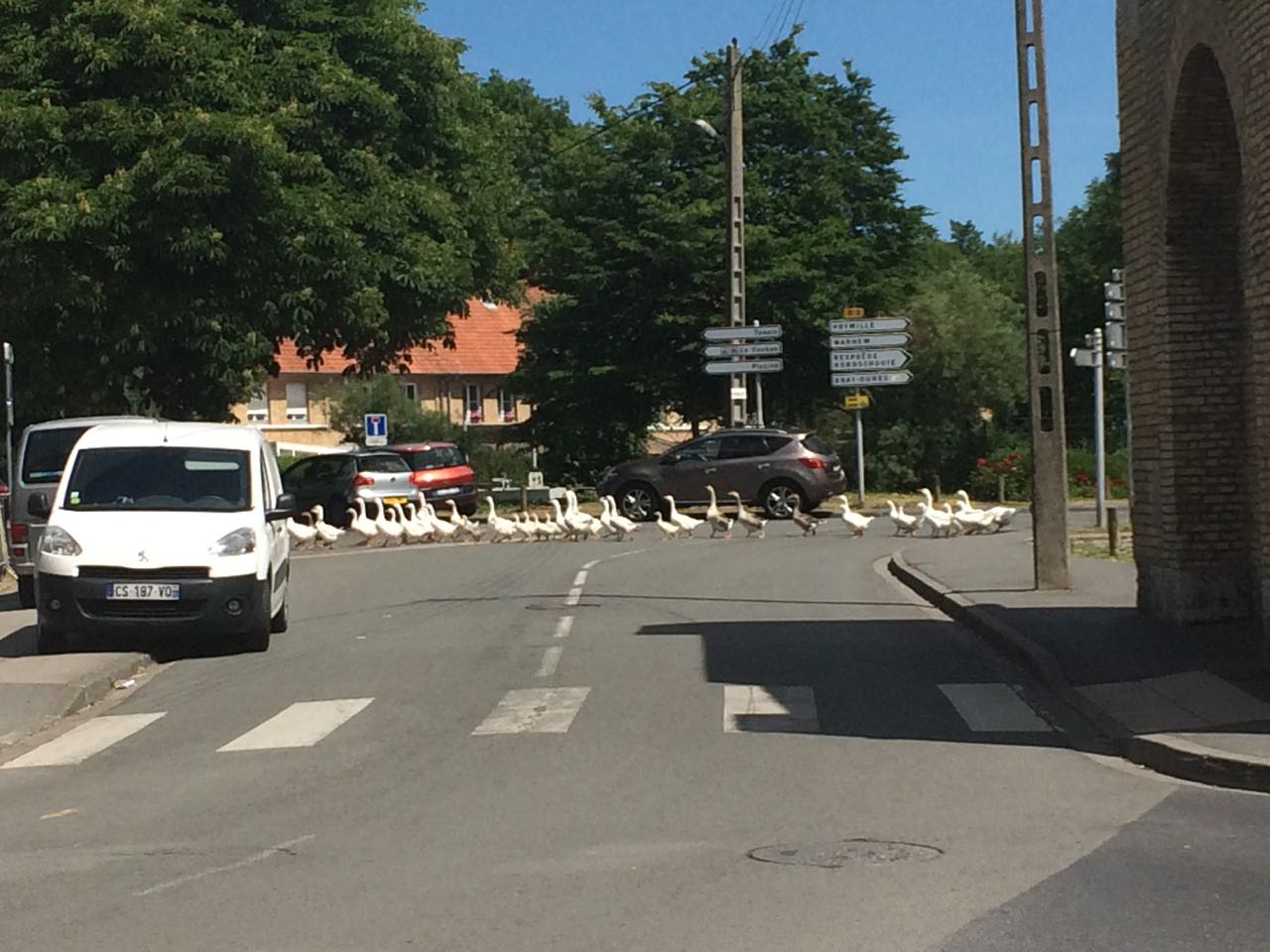
Bergues has a pretty big resident population of geese. During the daytime they hang out just outside the city walls at one end of the halte, occasionally deciding to cross the road to get at the grass on the 
other side and causing monumental traffic jams.


In the evening, they parade down the canal to wherever it is they go at night; around the corner and out of sight.

We spent Friday and Saturday just wandering around the town, taking the Ramparts Walk and the Guided City Walk.


And of course, climbing the belfort for a view of the city from above.


Sunday was the big sale. Usually the brocante sales are semi-professional antiques dealers with all manner of interesting things spread out on tables along the streets. This turned out to be more of a vide grenier, with everybody in town emptying out their closets and storage spaces trying to sell it all off. We spent a couple of hours wandering about but didn’t find anything to buy. We did find a good frites stand, though. Their version of the American (baguette with a sausage and frites stuffed inside) didn’t have the frites inside the baguette, just on the side as it should be. We’ve never been able to figure out why piling the fries inside the baguette is considered American.

We wanted to be back in Veurne early enough to take in the flower market so we shoved off a little before 9 in the morning. Luckily the lock and two lifting bridges on the French side were a model of efficiency (!) and we were tied up on a free mooring we found in Veurne, just before the Ieperbrug about 1 pm, plenty of time to walk into town and enjoy the market.